TIME COMMONS
时间公域

When life in its entirety becomes art, who defines the boundaries of the work? Who shapes the language through which it is interpreted? And how can villagers’ own voices remain the first to be heard, rather than the last to be acknowledged?
I have followed Yangdeng for a number of years. Recently, I read reports on this year’s Tu & Qi: Of the Soil, Out of the Ordinary Art Fair and came across a passage written by Jiao Xingtao himself. He described feeding images of motorcycles and women painted by the late village artist Li Huiqiang into an AI system in the hope of generating a sculpture. The images initially failed to pass the platform’s content review. Only after repeated deletions and revisions could a version be generated. The resulting sculpture was eventually installed amid more than a hundred confiscated, unlicensed motorcycles.
That detail made me want to write something considered, rather than simply add another voice of praise. This essay began there.
Yangdeng has now been unfolding for fourteen years.
Fourteen years is far longer than the usual timeframe for discussing an “artist residency.” Yangdeng now has a formally constituted art association, an ongoing exhibition programme, a dedicated research institute, government and corporate co-sponsors across several provinces and cities, and a working system that links artistic production, exhibitions, symposia, arts education and commercial agreements. This year’s programme alone names more than twenty organising and supporting bodies: municipal publicity departments, county government, several universities, leading academic journals and privately owned cultural-tourism companies.
This is no longer simply a relationship between one person, a group of students and a township. It is now supported by local government, higher education, the art market and the media.
One of Yangdeng’s most important achievements may be its move from an individual undertaking to an institutional practice. An art project rooted in rural life has found sustained resources, organisational stability and ways to reach people far beyond the locality itself. That was not easy. It deserves closer attention than labels such as “rural art” or “socially engaged art” usually allow.
But the same scale and stability also bring questions that once remained inside the practice into clearer view.
The question that first drew me to Yangdeng was this: must someone who has spent a lifetime farming, caring for a family and living by the rhythms of soil and season pick up a brush or carving knife before that experience can enter public culture? Yangdeng has arrived at an answer I had not fully anticipated. Experience no longer has to become a portable, collectible object in order to be recognised. The place itself becomes the work.
Writing about this year’s programme, Jiao Xingtao describes Yangdeng’s fourteen-year practice as a growing work of “ecological art.” Mountains, rivers, fields, buildings, villagers, artists, digital technologies, everyday routines and local governance all become part of what he calls “community art.” He compares the exhibition to an app’s home screen: an entry point through which visitors can see and take part in a life that keeps changing.
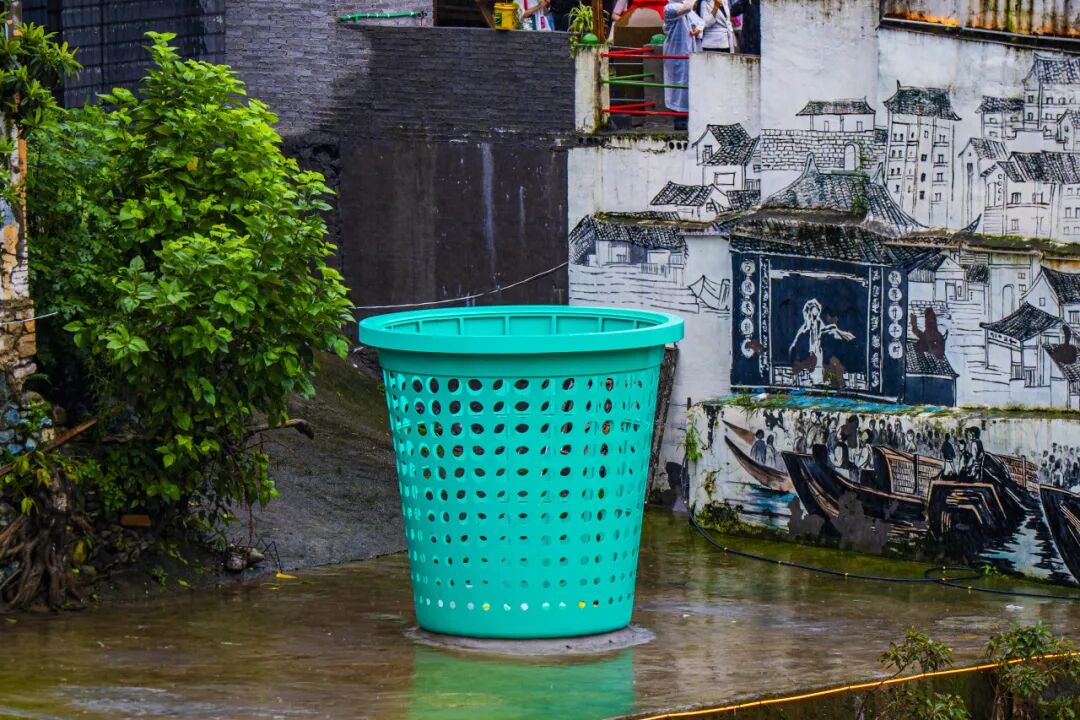
A forest ranger’s patrol logs become an exhibition. A disused distillery is adapted through what the organisers call “light intervention, with the original character kept firmly in place.” Exhibitions appear in breakfast shops, an old photography studio and an open stretch of riverbank; a trip to the market becomes a way of seeing art. Jiao placed an oversized green wastebasket beside the river. Villagers can deposit plastic bottles in exchange for “art points,” which circulate among the town’s storefront galleries and can be traded for everyday goods. Jiao says the idea first came from Yangdeng. He wanted to bring it back to the place and the people from whom it arose. None of this asks experience to take the form of a conventional artwork first.
In that sense, Yangdeng has moved beyond the assumption that art becomes valuable only when it takes material form as an object.
Once Yangdeng begins to treat the whole place as a growing artwork, questions that were once absent—or simply harder to see—start to surface.
The earlier question was whether a single artwork could carry one person’s experience fairly. The question now is whether the life of an entire place, once it becomes an artwork, can still belong to the people who live it. When a forest ranger’s logs, an elder’s remedies and a township distillery are gathered under the names “ecological art” and “community art,” do they also become things to be looked at? The large plastic basket by the river rewards people with redeemable points for depositing bottles. It recognises participation, but it also changes it quietly. “I happened to throw away a bottle” becomes “I completed an action that can be counted.”
None of this means that something has necessarily gone wrong. It does mean that boundaries once taken for granted now need to be discussed. Who decides where the artwork begins and ends? What about the parts of village life that are not recorded, photographed or entered into a points system—fatigue, arguments, silence, boredom, failure? Can they remain simply part of life, without being folded into the work?
Yangdeng has already answered whether life can become art. What remains is the question of whether, after becoming art, some part of life can still be left unseen.
Li Zhenhua’s foreword to Reconstructing a Bridge offers another example. This kind of curatorial writing gives international scholars and exhibition audiences a language through which to recognise Yangdeng. The foreword places Jiao Xingtao’s practice alongside the readymade tradition after Duchamp, Surrealism and magical realism, Zhuangzi’s idea of the equality of things, critiques of anthropocentrism, the idea of a community with a shared future for humanity, and commitments to carbon neutrality. Without this work of translation, Yangdeng would be much harder to discuss in Berlin or within international academic circles.
But because the language works so well, it raises another question: if a place is repeatedly described through a particular set of ideas, does that language eventually begin to remake the place? The title Reconstructing a Bridge refers to a swaying suspension bridge paid for collectively by villagers. They call it the “Happiness Bridge.” In the foreword, it becomes a metaphor for the whole collaborative project and is linked to the larger theoretical history above. As these layers of interpretation build up, how much space remains for the plain name the villagers gave the bridge themselves?
Did villagers help shape this language? Or does it mainly belong to curators and scholars who move between China and the West, while villagers are described through it rather than invited to write it with them?
The work involving motorcycles and the late village artist Li Huiqiang is harder to contain within theory.
According to Jiao Xingtao, he fed Li Huiqiang’s paintings of motorcycles and women into an AI system, hoping to generate a sculpture. The images initially failed to pass the system’s content review. Only after repeated deletions did he obtain an image the system would generate. That image was then converted into an AI-assisted 3D model, printed, and installed among more than a hundred confiscated, unlicensed motorcycles. Music played through speakers mounted on the vehicles as their engines idled and roared.
The work makes one thing plain: images painted over the course of a person’s life had to be reviewed, filtered and cut by an algorithm before they could appear again in the world. The artist did not choose that condition. He kept the process in his account of the work, and that honesty matters.
The issue is not AI by itself. Experience has always passed through filters before entering public view. Academies decide what enters art history. Exhibitions decide what enters public discussion. Markets decide what continues to circulate. Algorithms now have a hand in deciding what can be generated at all. The filter keeps changing; the act of filtering does not. What is different this time is how opaque the rules are, and how difficult they are to question. Villagers and artists have almost no say in setting those rules and little way of knowing what they are.
Li Huiqiang can no longer answer these questions. That is why the work cannot be discussed lightly. It brings an abstract problem to rest on a particular person who is no longer able to speak. We have to proceed carefully. A person’s death should not become evidence for someone else’s argument.
One other detail from this year’s programme is worth noting. Taozi Village named Fu Chenliang, Ren Hai, Li Zhenhua, Yang Xianzhong and Liao Denghai “honorary villagers.” Ren Hai is a distinguished professor at the Sichuan Fine Arts Institute and a tenured professor at the University of Arizona; Li Zhenhua is an international curator. Fu Chenliang and Liao Denghai have spent years doing the practical work behind Yangdeng’s exhibitions. The list brings together very different kinds of involvement: people who bring academic and curatorial resources from outside, and people who remain close to the place and carry its day-to-day work.
This raises a further question. As outside scholars such as Li Zhenhua and Ren Hai become “honorary villagers,” are villagers themselves gaining comparable opportunities to join international discussions, speak for Yangdeng and help shape the language used to interpret it? Public accounts tell us much more about how outside scholars and curators build relationships with Yangdeng than about how villagers enter wider conversations and take part in producing knowledge. That remains to be seen.
The association has made real efforts to include villagers, craftspeople, teachers and students. Some villagers have moved from paid installation work to making work in their own right. But as Yangdeng’s international story becomes richer, how much say do villagers have in making its meaning? Are they co-authors of that story, or mainly the people it describes and honours?
The same question applies to this essay.
An outside observer can raise questions but cannot answer for Yangdeng. We can recognise its historical importance and possible risks, but we have no right to prescribe where it should go next. The right to define Yangdeng belongs to its villagers, its initiators, those who have stayed with it over time, and the relationships they are still building.
Yangdeng has already moved far beyond painting and sculpture. Forest patrol logs, an old distillery, local remedies and everyday conversations with AI have entered public view in many different forms. It does not need an outsider to point this out.
Still, when life as a whole is called “community art,” when participation is turned into points, and when a person’s images must pass an algorithmic review before they can reappear, new questions follow. There are no ready answers yet.
Perhaps the next discussion within Yangdeng is no longer about whether painting or sculpture can carry lived experience. Since its first woodworking project in 2012, Yangdeng has already answered that question through practice. A different set of questions now lies ahead:
When the life of an entire place can become material for an artwork, do villagers still retain a part of life that remains entirely unwatched, unmeasured and outside every system of display?
As the language used to interpret Yangdeng becomes increasingly international and theoretical, are villagers helping to form that language, or do they remain primarily its objects of description?
When each era’s regime of visibility determines which experiences may be seen and which must first be altered or deleted, who is responsible for that filtering? Do villagers have the right to know about and negotiate its terms?
Outside observers, researchers and collaborators cannot answer these questions for Yangdeng. They can only be worked through slowly and honestly within the place itself—among villagers, artists, teachers, the association and everyone who has stayed involved over time.
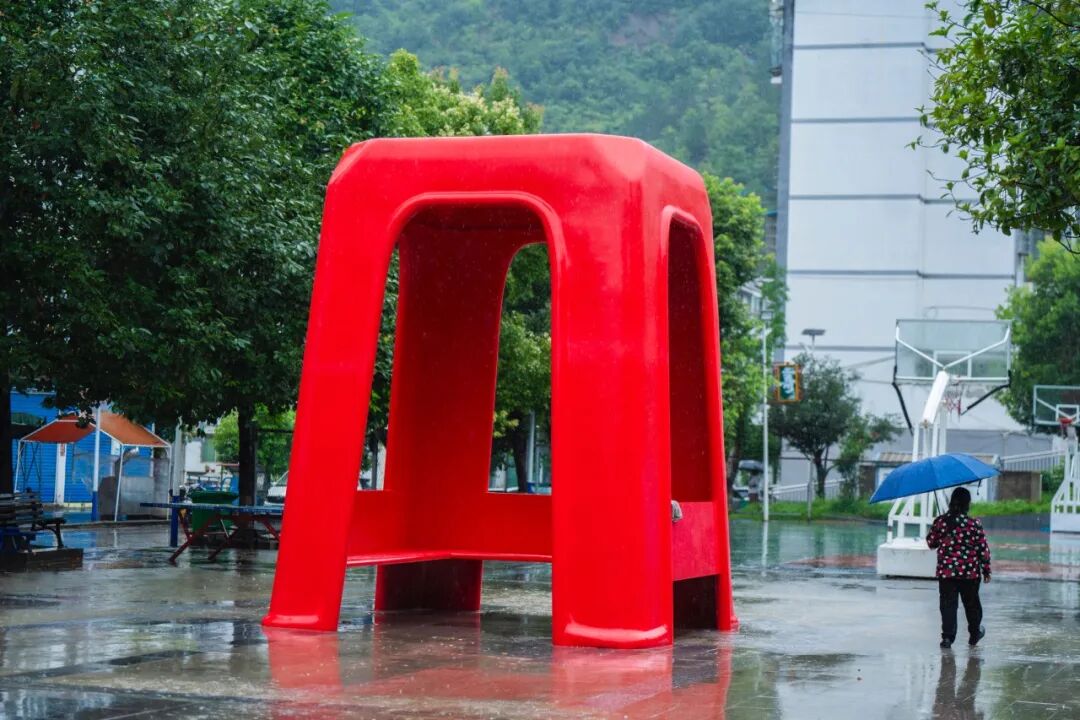
Over fourteen years, Yangdeng has brought ordinary lives into art and then made the place itself the work. It may now face a harder question:
Once life as a whole has become art, how can the voices of villagers remain the first to be heard within the work, rather than the last to be acknowledged?