TIME COMMONS
时间公域
Vibration Hamburg:
Sealtan Project · Europe Chapter
By Michael Suh / Curator
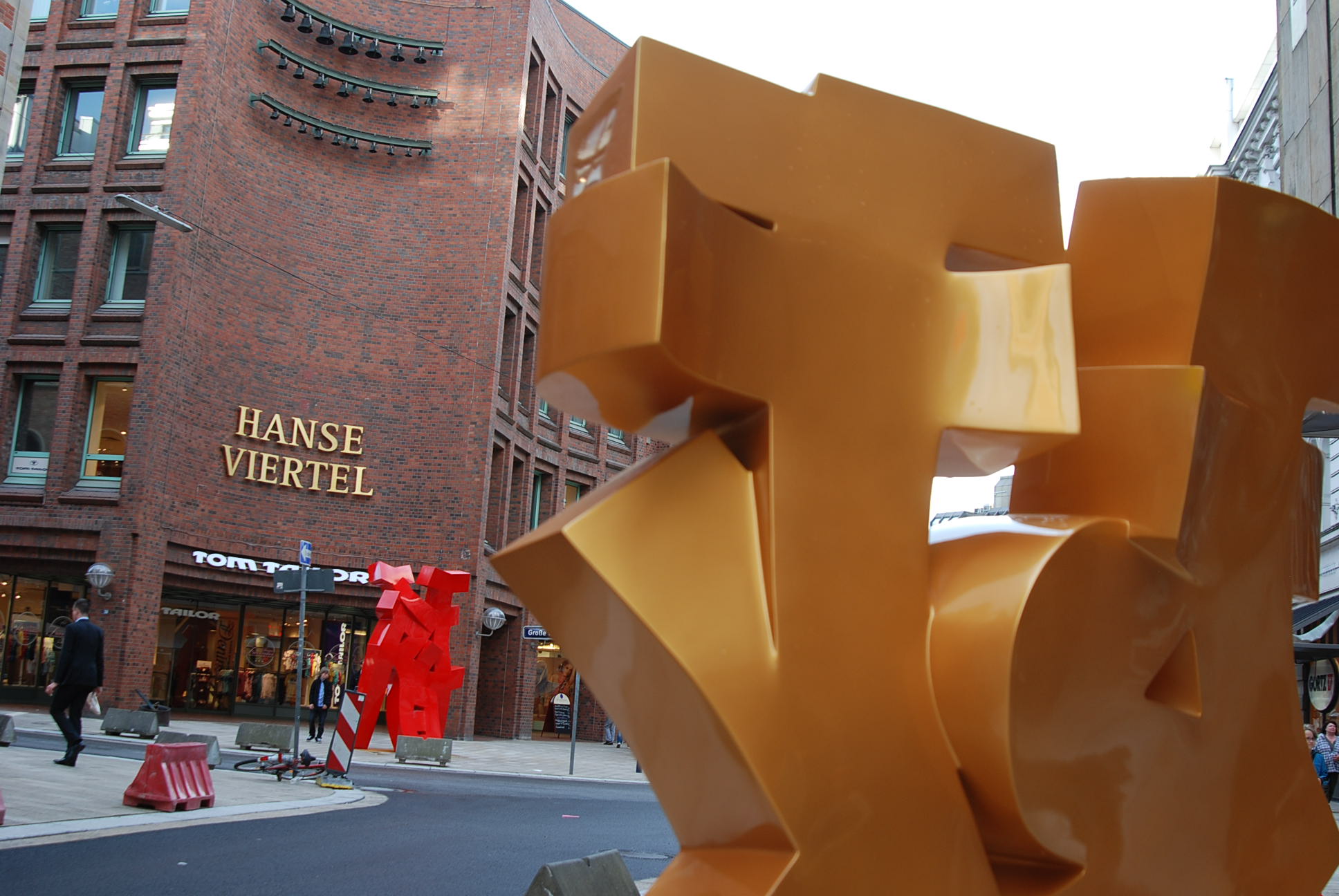
When I return to Hamburg in language rather than in memory, Großen Bleichen no longer appears as a street I once walked through, but as a structure rising again from the deeper layers of time—an unfinished field of energy waiting to be reactivated. The eighteen sculptures shown here twelve years ago did not disappear when the exhibition ended; they sank into duration, suspended like latent forms awaiting a second articulation. Writing, therefore, is not an act of recollection but an act of re-staging; not a commentary but a renewed construction of relations. Hamburg must be reopened in this manner because it was the first node in the European trajectory of vibrARTion—a beginning whose latent structure demands a more mature and structurally conscious form of writing in order to be properly held.
In 2012 the exhibition unfolded within a cultural atmosphere that still believed in the possibility of a China–Europe intellectual dialogue. Tang Yao’s preface captured that moment: the historical crossings of two civilizations, the philosophical correspondences, the desire for a renewed conversation. Today, this text should no longer occupy the foreground. It remains as a faint background texture—an atmospheric layer reminding us of the cultural winds in which the exhibition once occurred—but the narrative force now belongs elsewhere. What must be reconstructed is not the prefatory climate but the structural anatomy of the exhibition itself: the eighteen works, their materials and energies, their modes of appearance in a foreign public space, and the ways in which they reorganize themselves when re-entered through the lens of Sealtan writing.
The archival documents record the works clearly—artists, materials, dimensions, dates. Building upon this factual ground, I reorganize the exhibition through energetic relations rather than through spatial sequence. In this reconstruction, the Hamburg exhibition reveals itself as a system composed of four interacting lines of force: the Structure Line, the Life Line, the Form Line, and the Resonant Distance Line. These are not themes; they are the modes through which the works distribute their energies across the site, and the ways in which the exhibition continues to operate within the present moment of writing.
—Material, Layer, and the Organization of Time
The structure line begins with two works by Huo Boyang. This is not an interpretive gesture but an observation grounded in the works themselves: the twenty-year interval between Walking (1992) and Spring 2012 (2012) marks a decisive transition in Chinese contemporary sculpture—from figuration to structure, from representation to material logic.
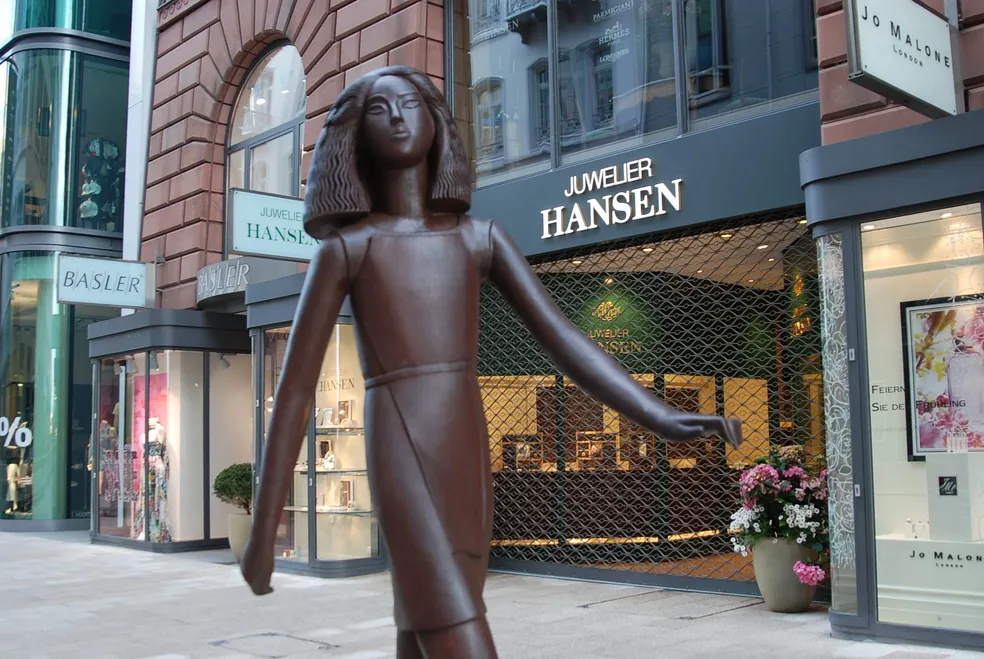
Walking still bears the imprint of academic realism: the skeleton is faithfully modeled, the musculature intact, yet something inside the form is already shifting. The mask-like face, the seam-like joints, the irregular rhythm running through the limbs—these are not stylistic choices but early signs of an internal rupture. In the early 1990s, many Chinese sculptors found themselves in this tension: realism remained institutionally dominant, yet the need to break away from its constraints was increasingly urgent. The form stands as if on the brink of shedding its own descriptive function.
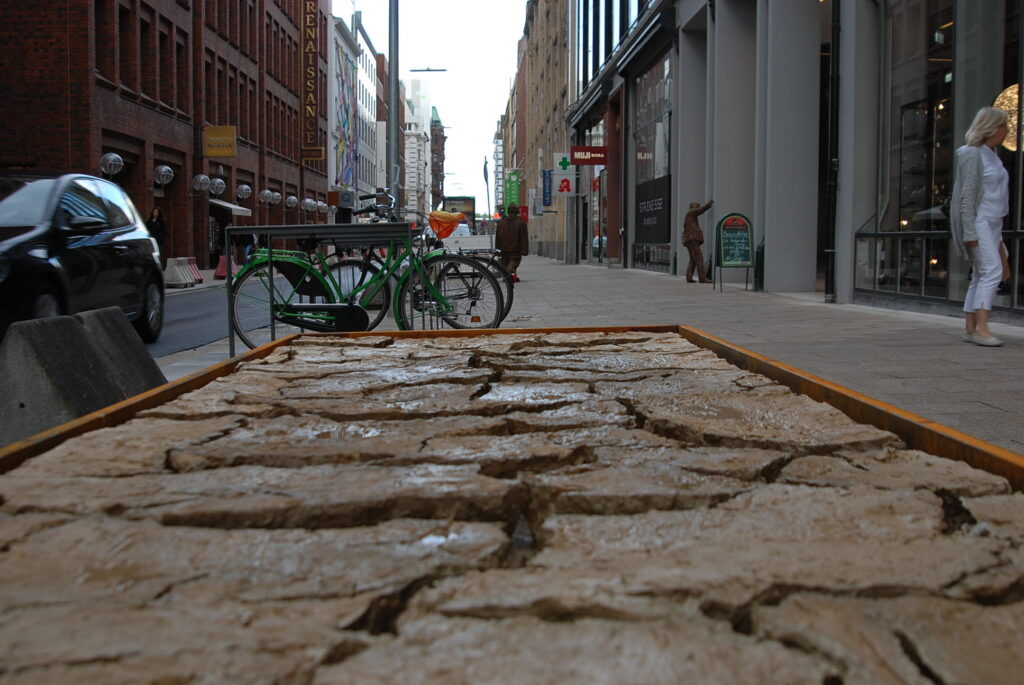
Two decades later, Spring 2012 completes that shedding. The figure is gone; what remains resembles a dry, cracked terrain. The surface carries striations like geological layers, fissures like dried earth, a tactile time-depth that no longer belongs to the human body. The work does not “depict spring”—it performs a return of time itself, a renewal that occurs not in imagery but in the material’s latent memory. Representation has completely withdrawn; structure has taken its place.
Placed together, these two works form the first coordinate of the structure line: body and stratum. The body is the surface of time; the stratum is its sediment. Their interval forms one of the deepest temporal cuts in the exhibition.
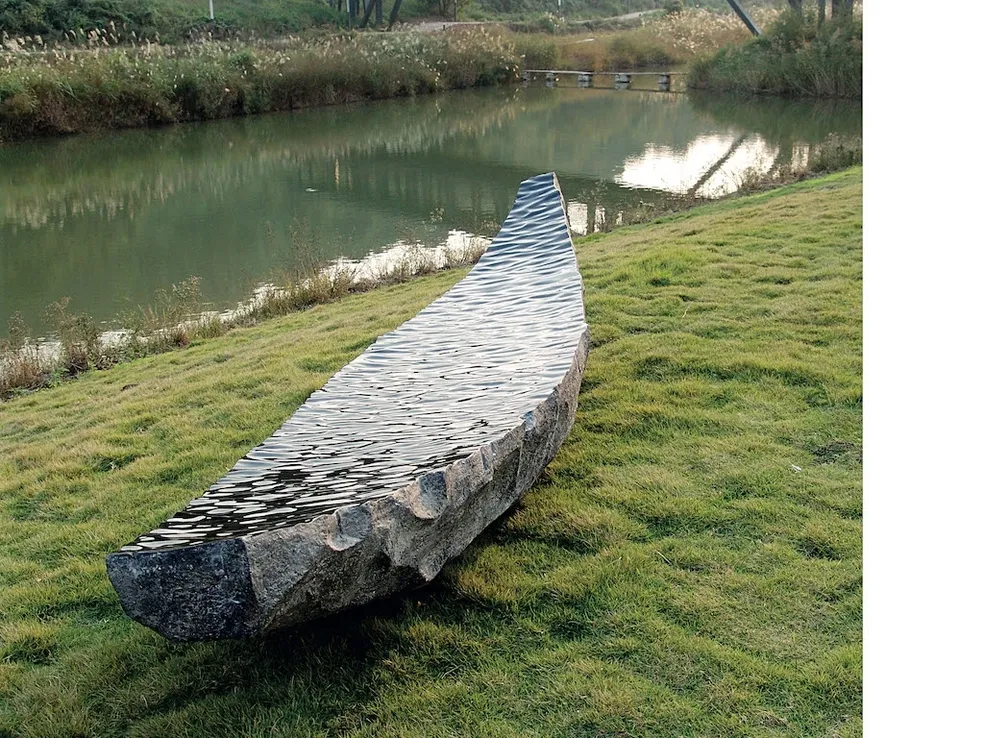
Shen Lieyi’s A Boat carries the structure line from the geological to the spiritual. Removed from any actual water, the boat becomes a distilled form of inward stillness. Collector Sergey, in his personal note “Reading Works”, wrote only two words—calm and concentrated. The simplicity of this response is revealing: the work bypasses conceptual mediation and enters directly into a spiritual register.
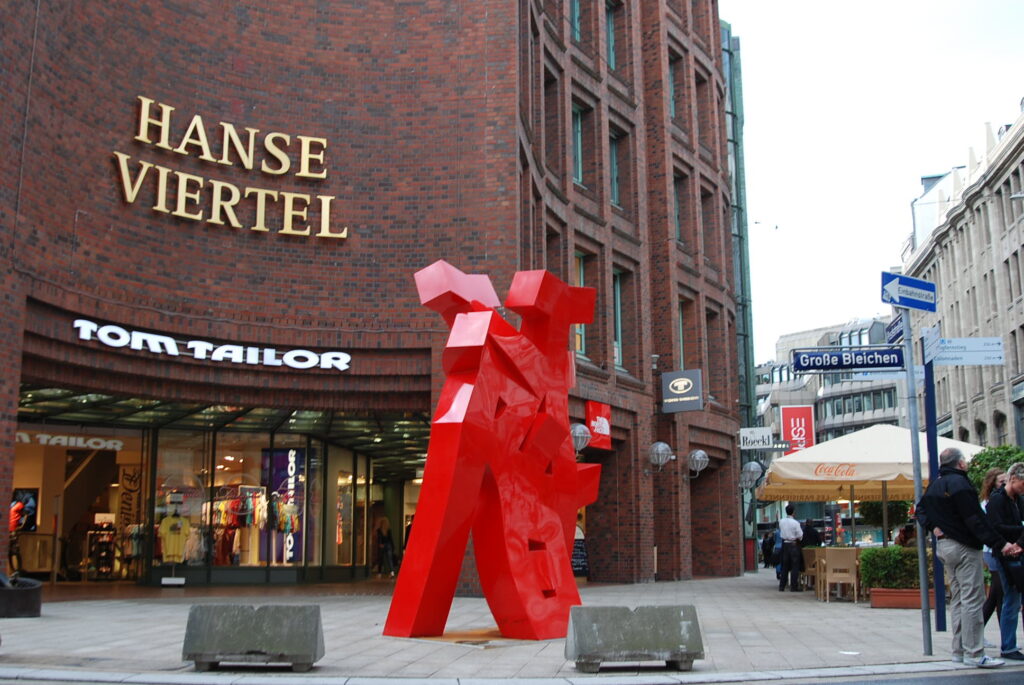
Liu Yonggang’s monumental characters—Double Enlightenment and Harmony—further extend the structure line into the domain of enlarged symbols. The characters do not function as semantic carriers in the European context. As Dr. Jürgen Fitschen later observed, they shed their meanings and become “pure structures of presence,” masses of energy appearing without linguistic mediation. The structure line here is no longer figurative or spiritual; it is architectural, iconic, and ontological.
Thus the structure line is composed of three strands: temporal depth (Huo), spiritual clarity (Shen), and symbolic mass (Liu). Together they form the exhibition’s foundational architecture.
—Three Logics of Living Form: Natural, Psychological, Social
The life line is not biological. It is the way life organizes itself across nature, psyche, and society.
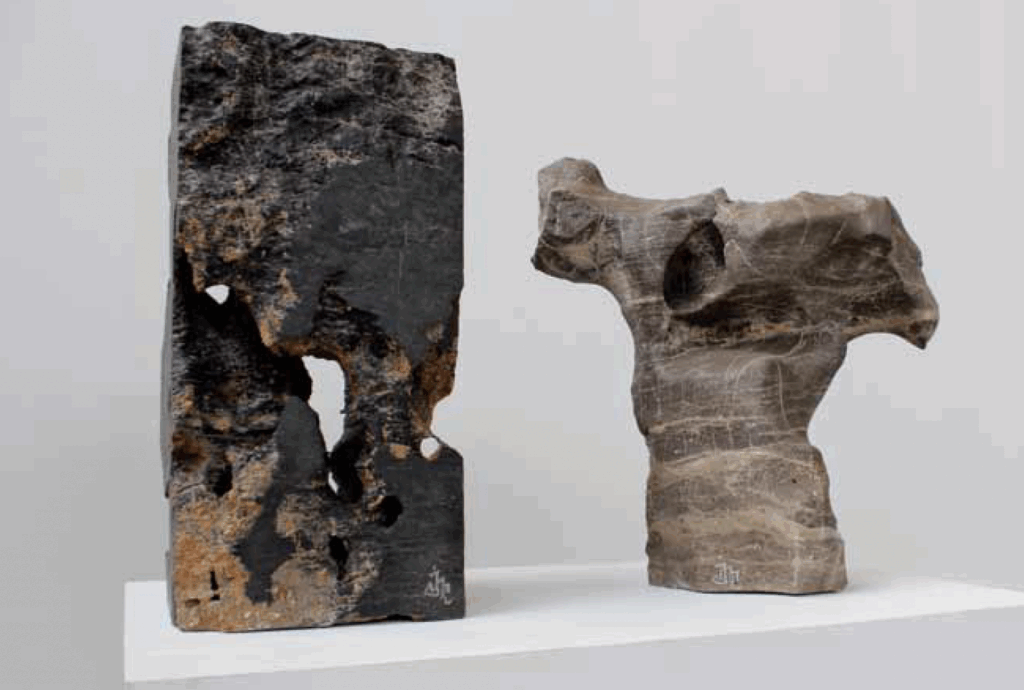
Zhang Yongjian’s Dream introduces natural life. The Taihu stones breathe: their holes function like lungs, their water-marks like arteries. These are not landscapes but living structures—slowness, sedimentation, a circulation older than any body.
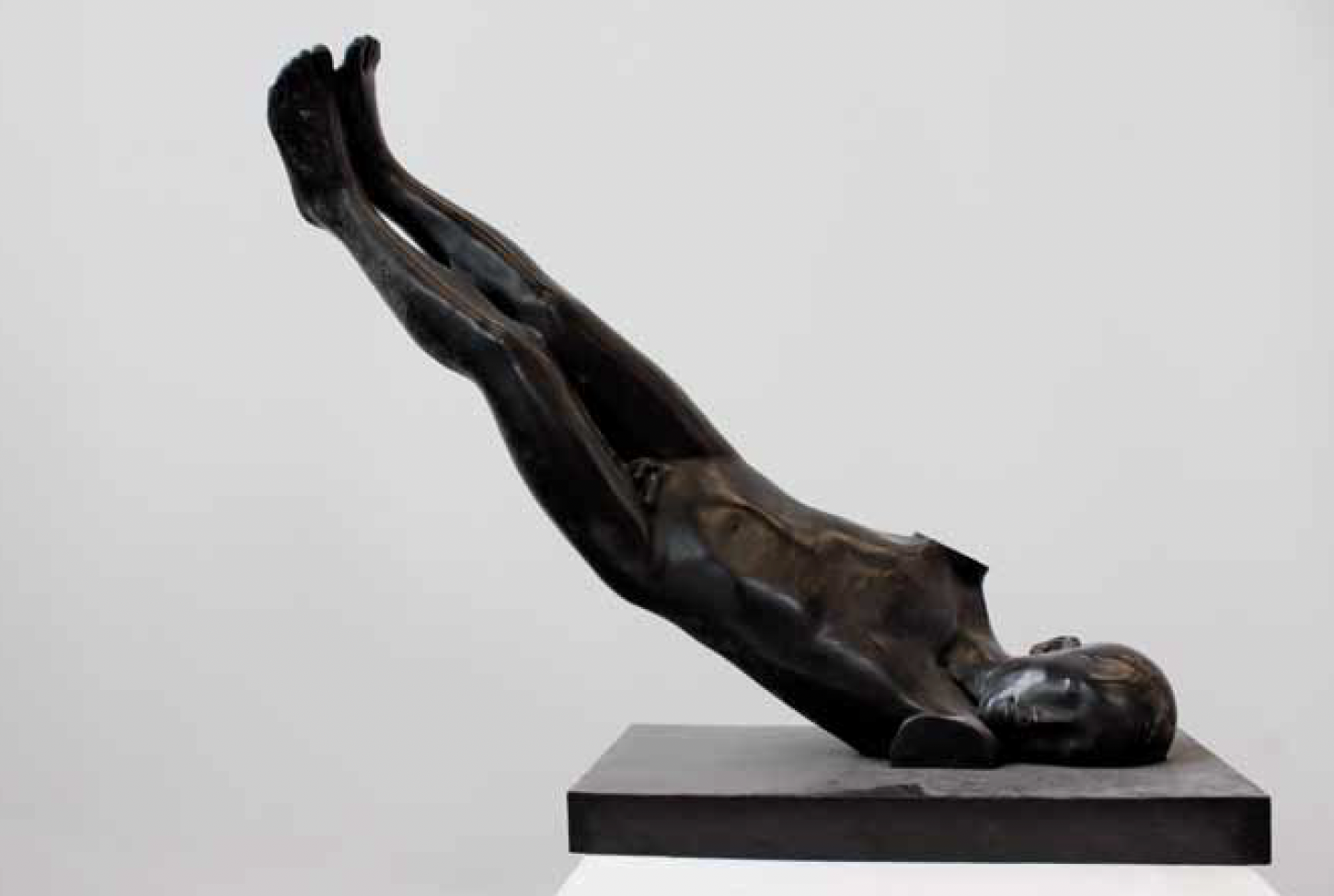
Liang Yankang’s Carrying and Falling introduce psychological life. The gestures of strain, imbalance, descent—these are not narrative actions but emotional structures made visible. Fitschen calls such bodies “estranged bodies,” retaining weight but losing equilibrium. Their instability reveals internal tension, not external story.
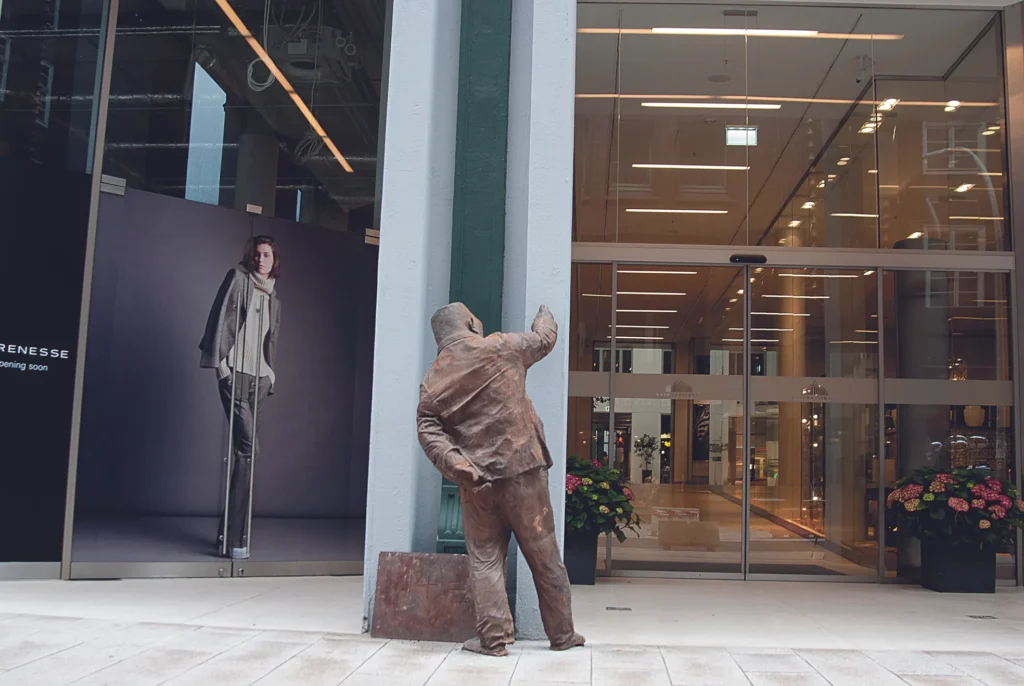
Zhang Jianhua’s The Farmer Carrying Meat and The Village Teacher bring social life into the exhibition. The dragged meat, the raised arm—these are materializations of social weight. They do not illustrate hardship; they embody its gravitational force. When placed in a European commercial street, the works acquire an intensified displacement: the social becomes trans-cultural, the weight becomes universal.
Here Sergey’s Reading Works enters as a micro-line: his handwritten impressions—“breath-like openings,” “inward,” “quiet pressure”—record the smallest oscillations of encounter. These notes have no interpretive ambition, and precisely because of that, they trace a layer of life that the major structures cannot capture: the intimate vibration passing from work to viewer. They complete the life line by providing its finest grain.
Thus the life line unfolds across nature (Zhang Yongjian), psyche (Liang Yankang), society (Zhang Jianhua), and micro-sensation (Sergey).
—Viewing Structure and the Materialization of Perception
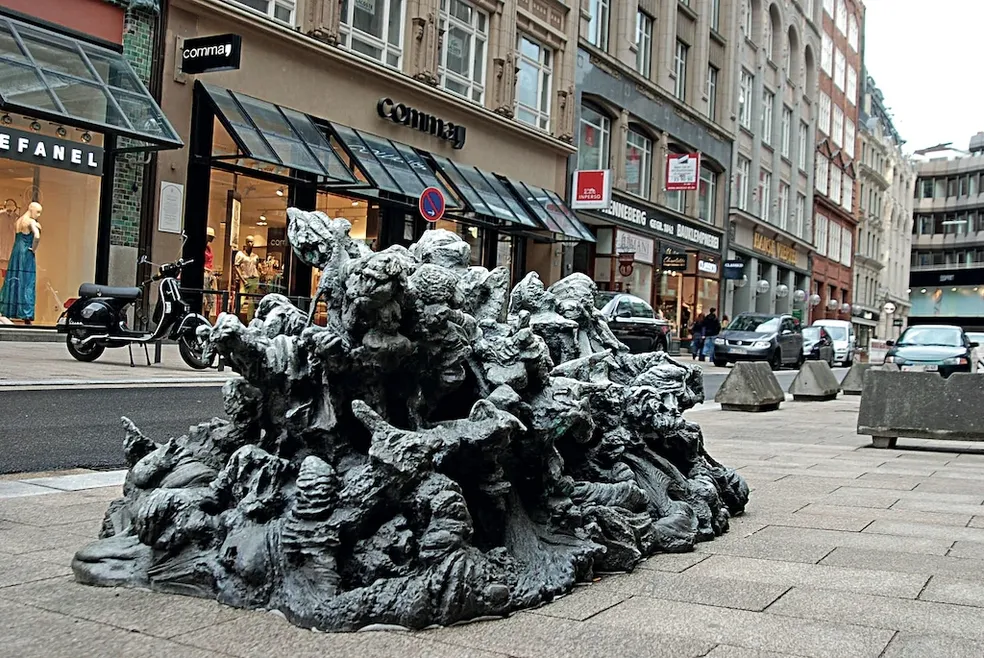
Li Zhanyang’s trio—Strange Loop, Barren Hills, Void—constitutes the basis of the form line. Each work is less a form than a mechanism: a viewing device. Loops, accumulations, apertures—these operations organize the viewer’s movement, attention, and orientation.
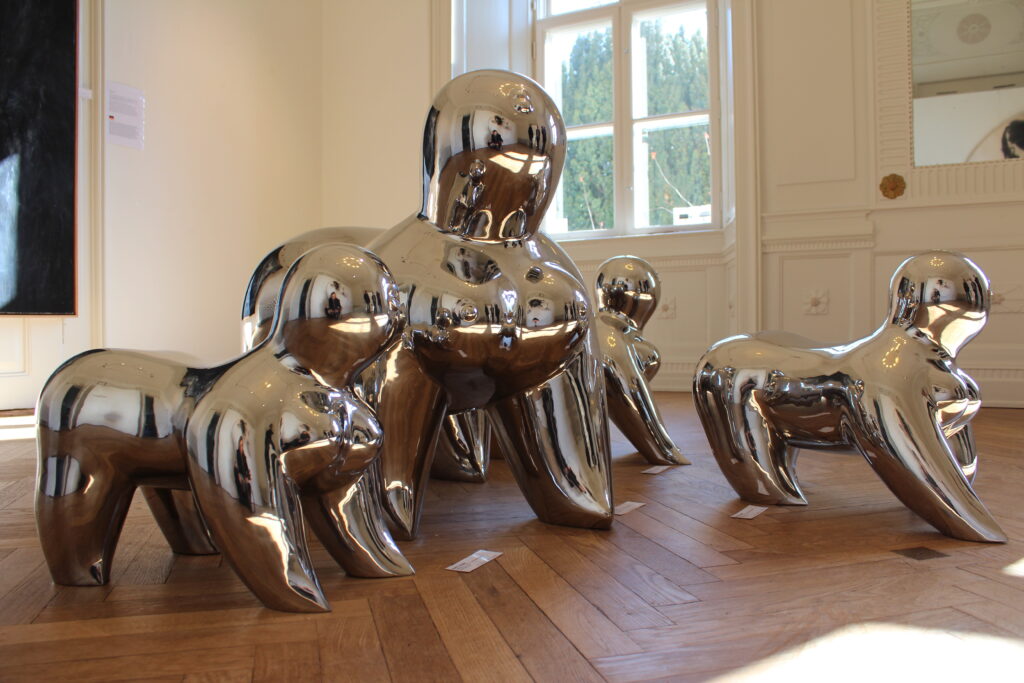
Pang Yongjie’s reflective Walking extends this into a reflexive seeing. The mirrored surface captures and distorts the viewer, forcing perception to account for its own presence. The form line is thus not about form but about the conditions of viewing—how space looks back.
—Cross-Cultural Delay and the World’s Echo
The final and most concealed line of the exhibition is revealed only retrospectively, through the text Dr. Jürgen Fitschen wrote after encountering the works. His perspective is not supplementary—it is the other end of a vibration. His distance is structural, not geographic.
Fitschen observed that Chinese works in European public space generate a “delay in judgment.” This delay is not confusion; it is a form of openness produced by the suspension of meaning. The works cannot be absorbed into familiar cultural frameworks, and thus their material and energetic intensities come forward with unusual clarity.
In his reading of Liu Yonggang’s characters, he argues that their semantic content disappears in Europe, leaving behind “pure appearing.” Meaning dissolves; presence amplifies. This is the essential mechanism of the resonant distance line: the work gains strength precisely where it loses legibility.
The resonant distance line reveals how the exhibition extends beyond Hamburg’s streets into the world’s cultural field. It shows that vibrARTion’s founding proposition—to begin in China and resonate outward—is not a metaphor but a literal structural behavior. The works do not cross cultures; they vibrate between them.
When these four lines—structure, life, form, and resonant distance—are placed into relation, Hamburg is no longer an exhibition from 2012 but a resonant field reopened in 2025. Writing becomes the second activation of the site. The works shift from being objects in space to being nodes in a structural field.
Hamburg is the first European hall of Sealtan not because it happened first, but because it contains the originating tension: works leaving China, entering the world, and returning not as confirmations but as vibrations. Judgment continues in delay; resonance continues in distance.
The exhibition has ended, yet its energy remains unexhausted.
The works have sunk into time, yet their structures continue to grow.
Re-entering Hamburg in language means recognizing that its vibration never ceased—it only awaited the moment when its structure could finally be written.