TIME COMMONS
时间公域
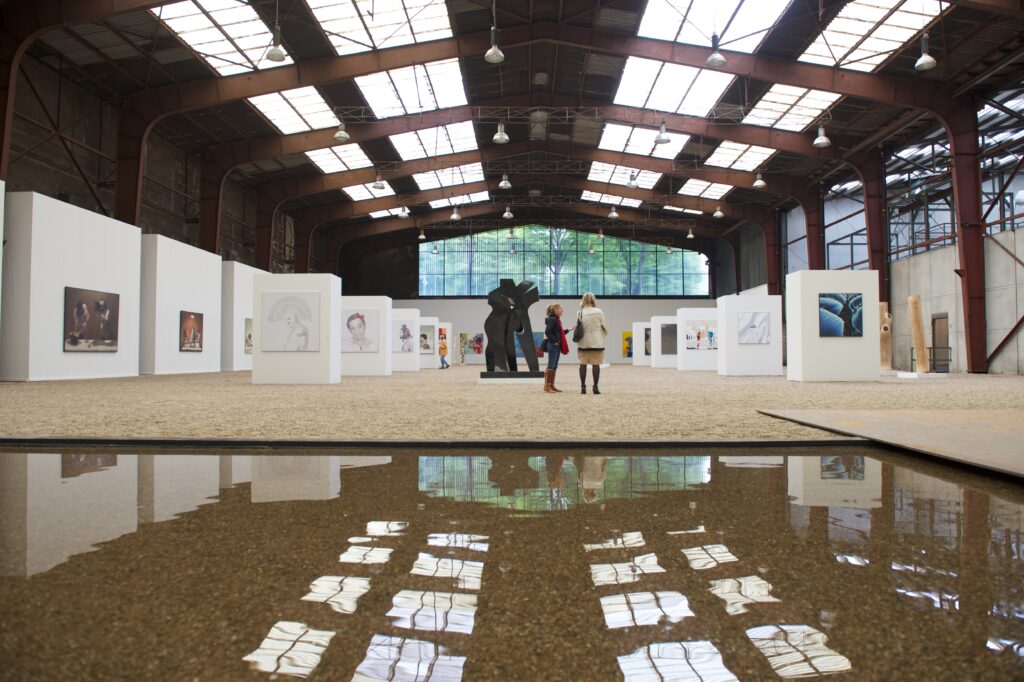
In 2012, “Forms of the Formless” opened as Action 2 of the vibrARTion Project at NordArt. The exhibition explored the “formless structures” of contemporary Chinese art, staging a constellation of sculpture, installation, painting, and video in a nineteenth-century industrial hall. Within this spatial and material framework, the works generated new resonances across scale, media transformation, and temporal perception.
Here, the works of Chinese artists were no longer presented as a “national pavilion,” but entered an operative context within a long-running international contemporary art institution, situated among—and in dialogue with—artists from around the world.
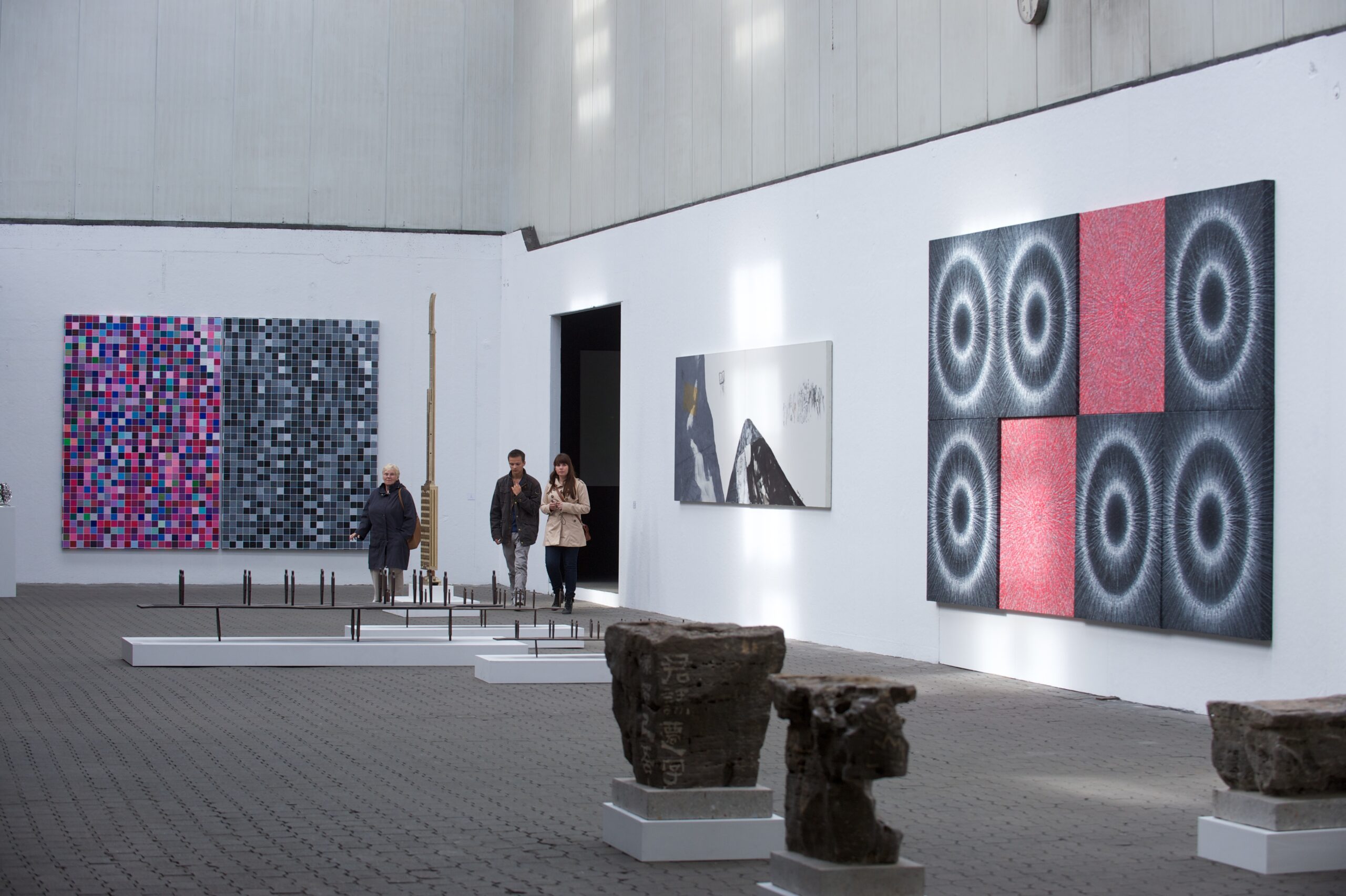
NordArt occupies a former steel-factory hall whose skylights, rust-colored beams, and concrete floors preserve traces of industrial history. “Forms of the Formless” introduced large white walls and platforms within this environment, creating a “second space” where the clarity of display structures coexisted with the factory’s raw material memory. Visitors experienced the show simultaneously through the white surfaces and through the faintly persistent temporal layers of the hall—the history of the site, the time of materials, and the historical depth carried by Chinese works.
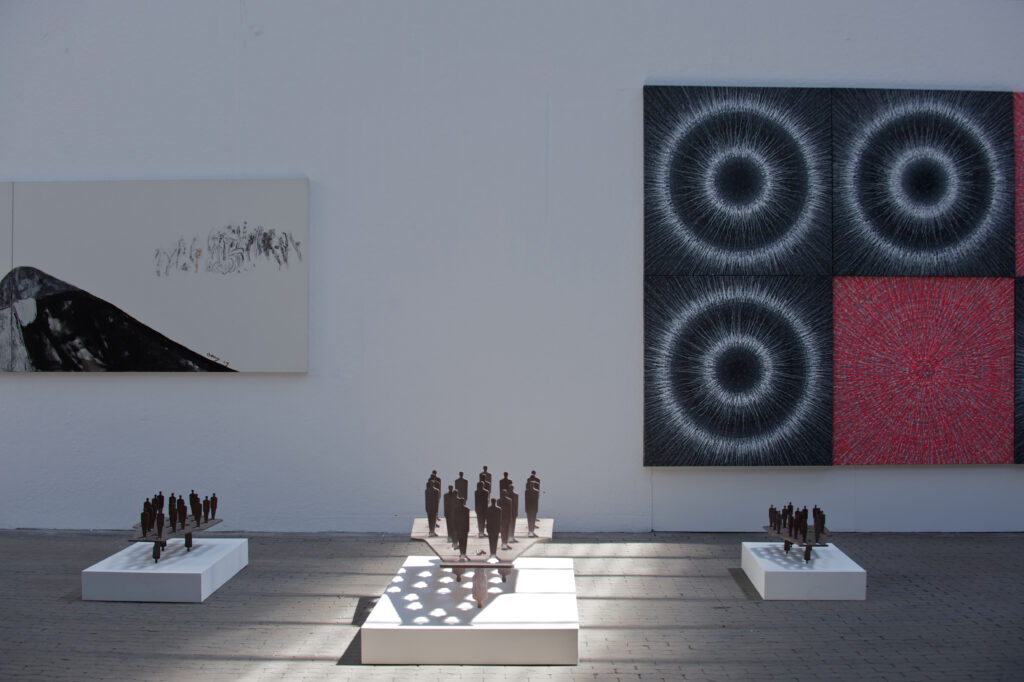
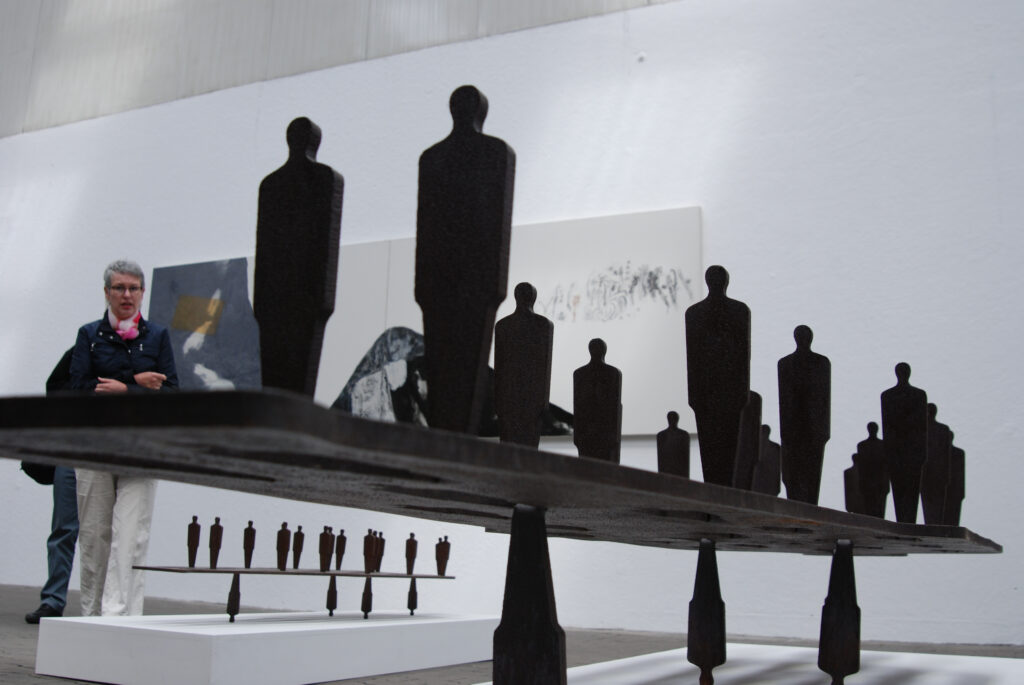
In this juxtaposition, Fu Zhongwang’s repeated human silhouettes—cut from steel plates—are placed in the foreground on slightly elevated platforms. They resemble a provisional tribunal, or the shadow of a crowd standing on the remnants of an industrial ruin. Behind them hangs Shang Yang’s monumental “ruin-landscape” painting, where fragmented stones, rubble, and dust are condensed into an abstracted geological memory. Together, the two works construct a “body–stratum” coordinate within the same field of vision.
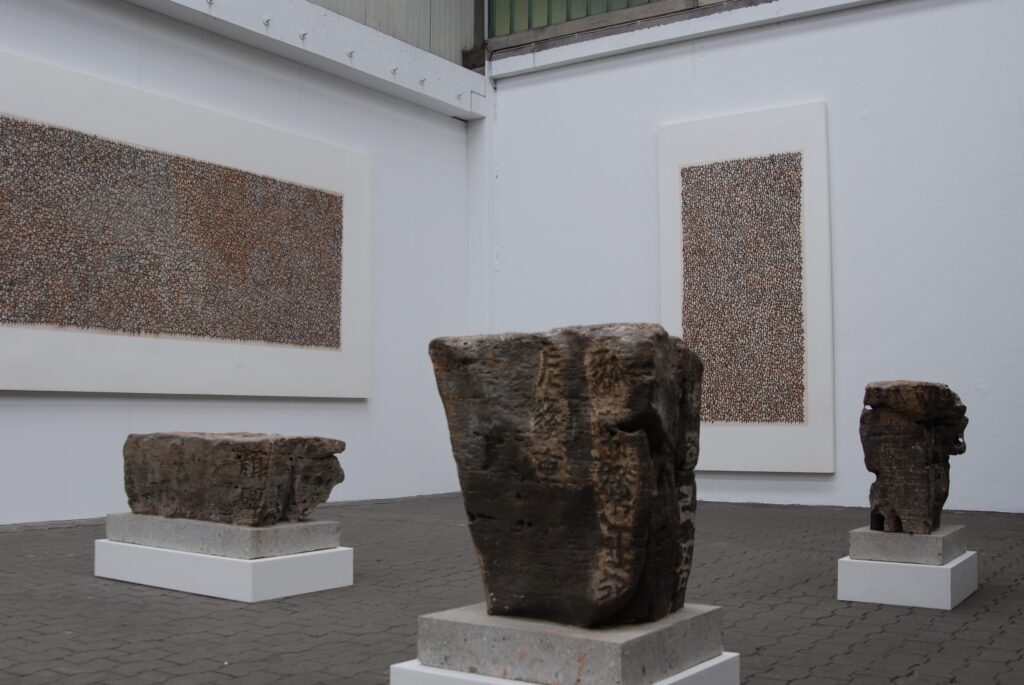
In the foreground, Zhang Yongjian places three mechanically cut Taihu stones whose surfaces retain weathering marks and carved characters, as if extracted from dismantled architectural remains. On the back wall hangs Liu Xuguang’s dense ink-dot paintings, turning the canvas into a vibrating “temporal screen.” Stone and painting stack vertically before the white wall, offering two different material compressions of historical information.
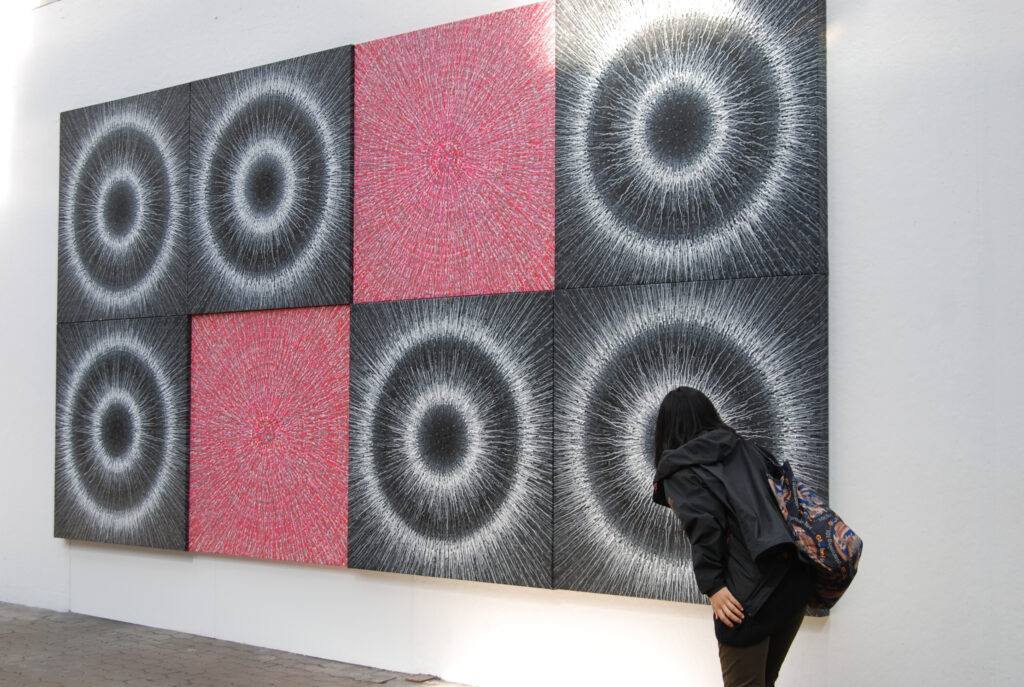
Meng Luding’s works are produced through mechanical spraying devices, generating large color fields that assemble into pixel-like grids on the exhibition walls. Combined with the natural skylight descending from NordArt’s tall ceilings, the works inhabit a space between painting, print, and screen, introducing a visual language closely tied to “mechanics–algorithm.”
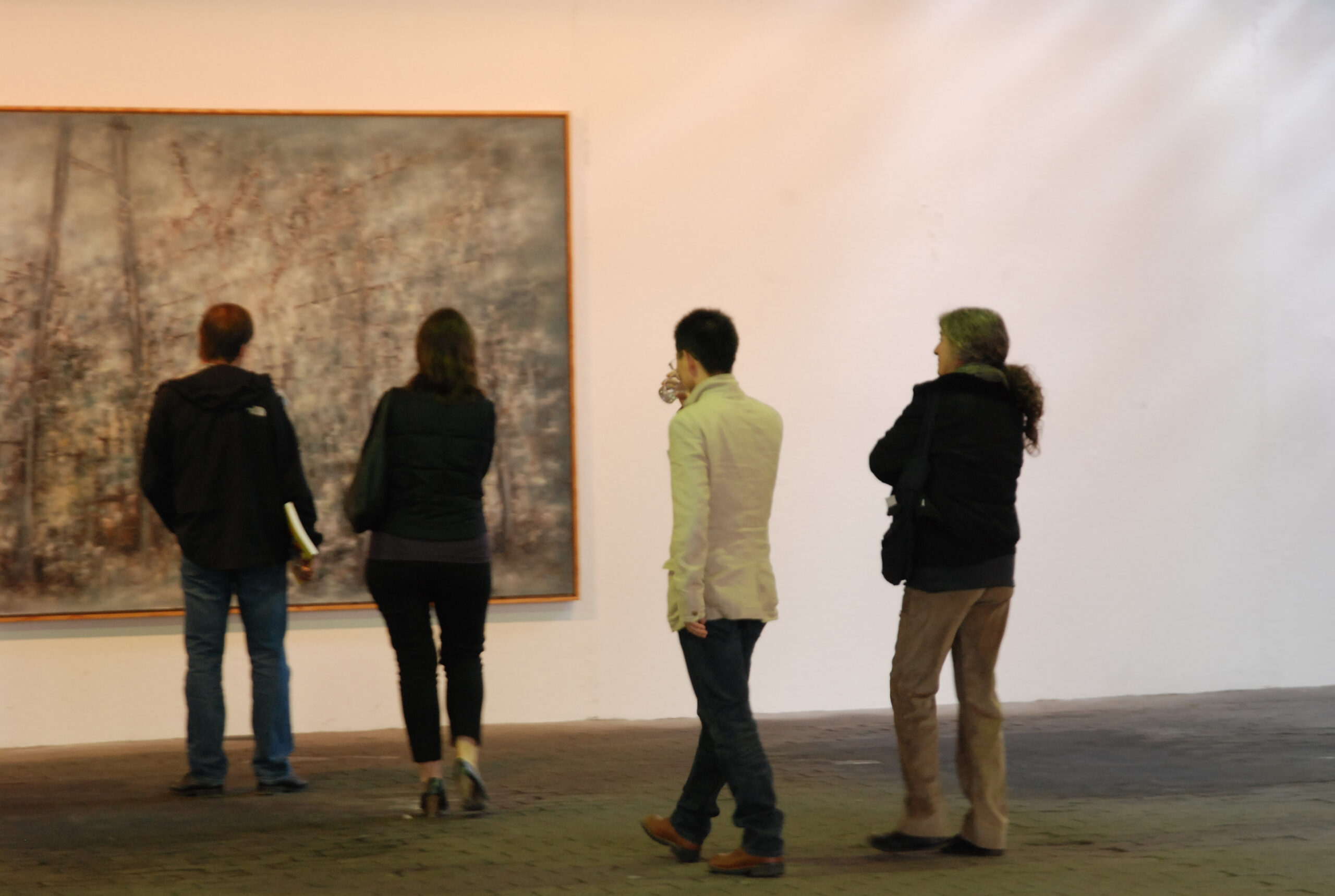
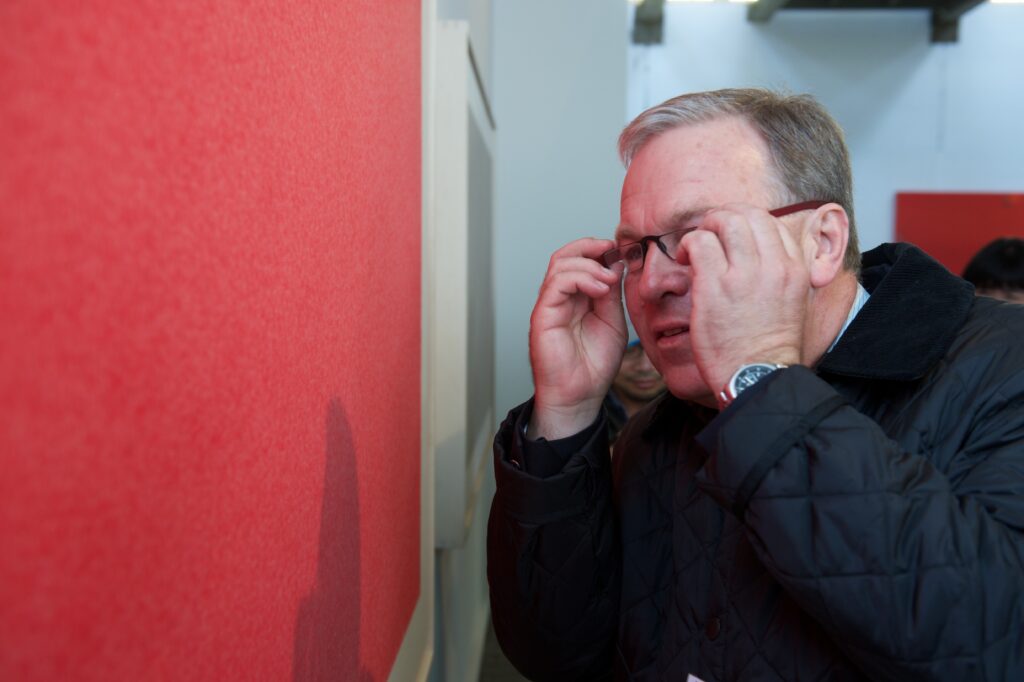
Zhang Yu’s large red fingerprint piece hangs along one side of the hall. From afar it appears as a nearly uniform field; up close, every fingerprint ridge and pressure trace becomes visible. During the exhibition, an important NordArt supporter—and owner of the Carlswerk Art Center— examined the work at extremely close range, embodying the “temporal attentiveness” the work demands.
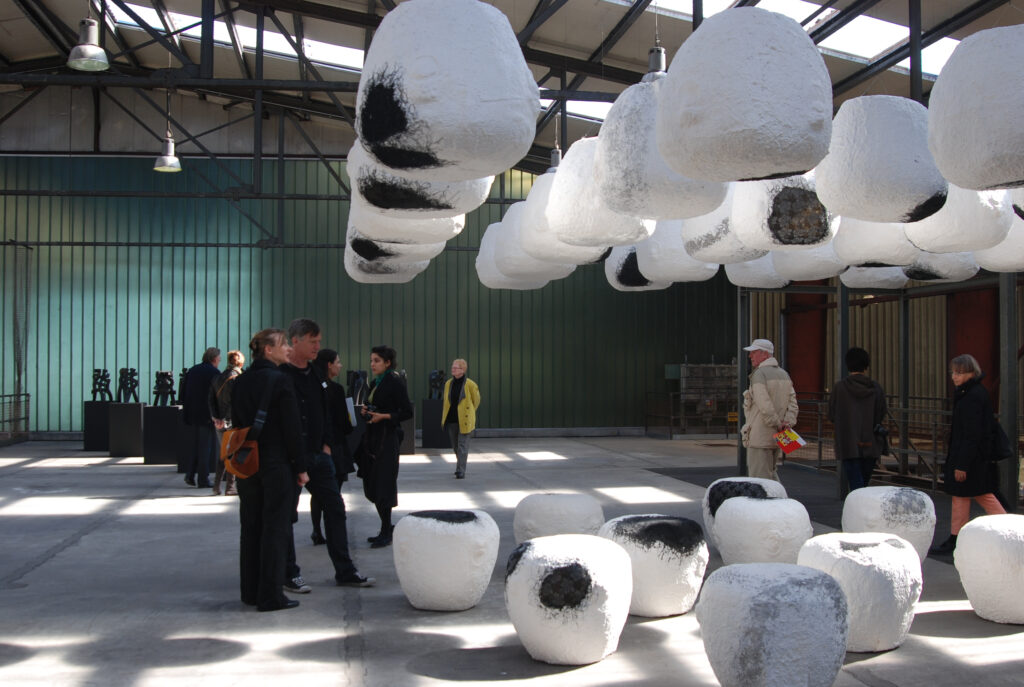
Shi Hui’s large installation—constructed from pulp, fiber, and coal ash—occupies an entire high-ceilinged hall. The suspended white masses echo the forms placed on the floor, while the burned black edges generate uncertain boundaries. The sheer scale of the work redefines the hall’s dimensions, prompting viewers to perceive their own bodies anew as they navigate the space.
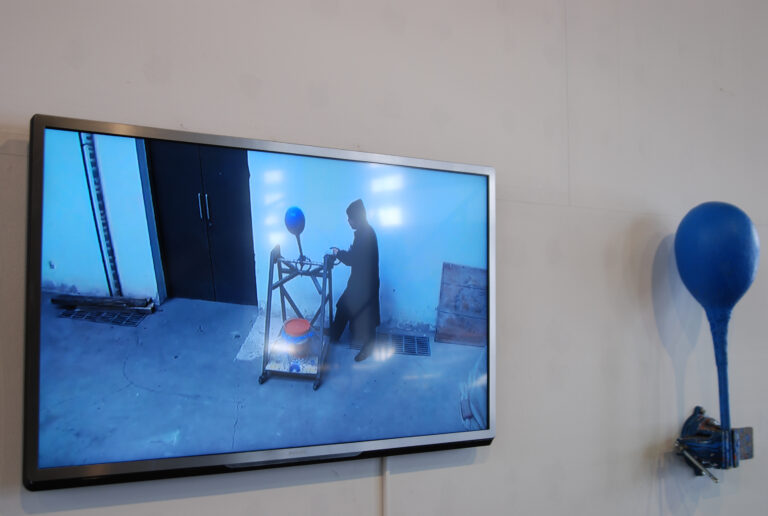
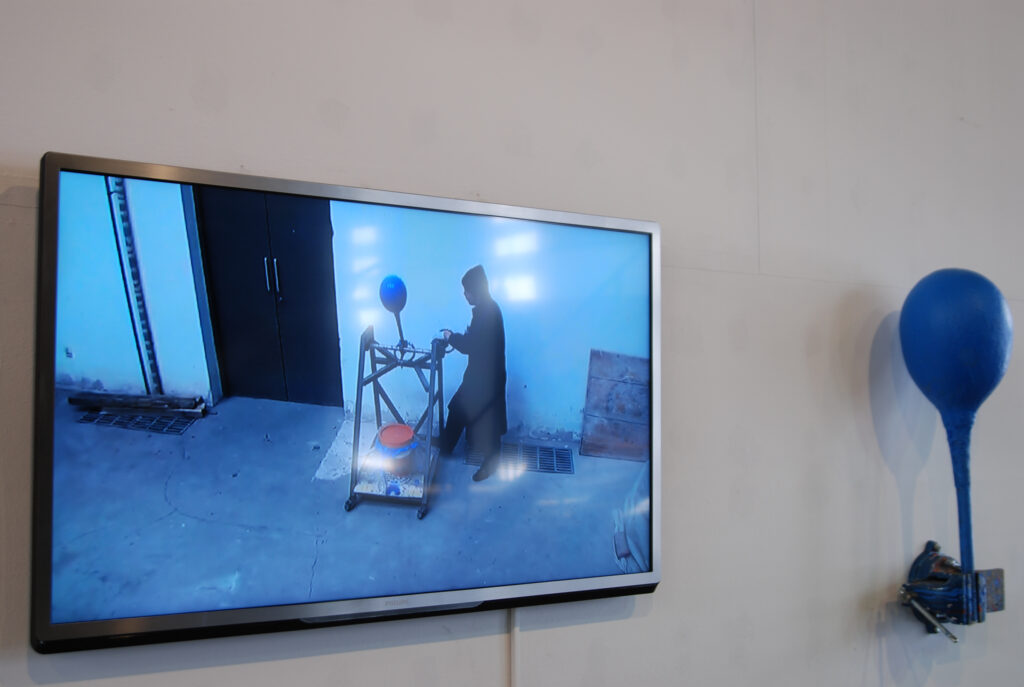
Sui Jianguo’s The Shape of Time appears in two parts at NordArt: the sculptural object that has been “growing” for six years, mounted on the wall and marked by accumulated traces of dripping pigment; and a video documenting the making process, showing the continuous dripping, layering, and solidification of paint. Moving between the video and the physical object, viewers realize that the form they see is merely a cross-section of an ongoing temporal process.
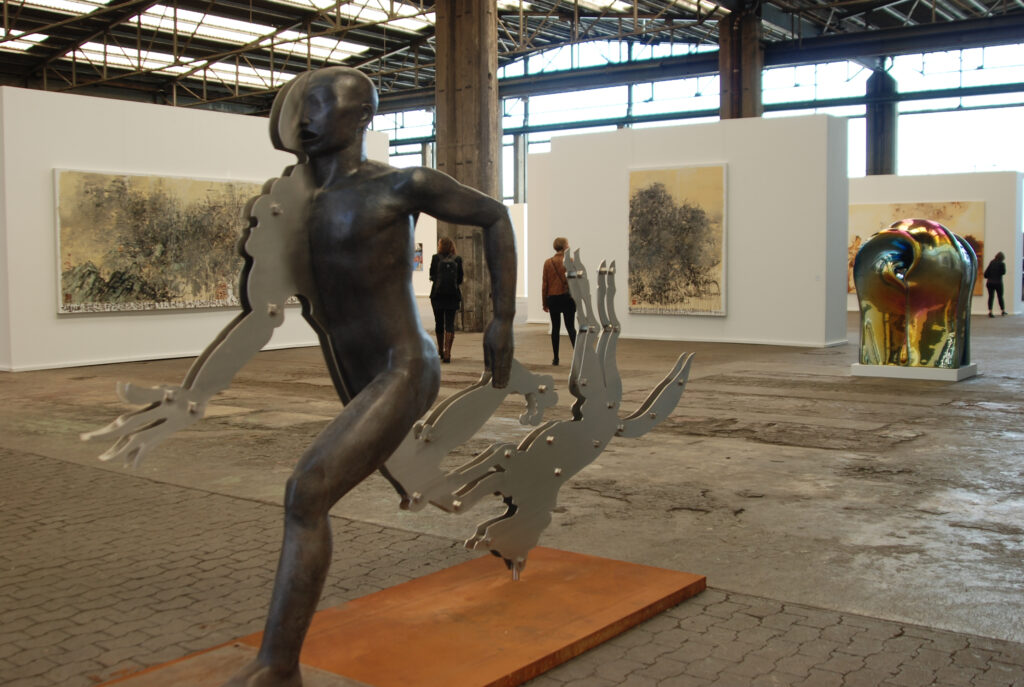
In the outdoor sculpture park, Feng Chongli reinterprets the traditional Chinese motifs of plum, orchid, bamboo, and chrysanthemum through stainless steel. What originally belonged to the symbolic vocabulary of literati painting becomes, in metal, a tension between “growth” and “industrial surface”: the cut edges of the steel carry a structural rigor, while the overall rhythm of the forms retains the spirit of uprightness and resilience associated with these plants. His work stands at the intersection of classical imagery and contemporary materials. Inside the main hall, Wang Zhong’s The Fugitive depicts a figure in forward motion, cast in bronze and accompanied by stainless-steel “afterimages” that trail behind the body. The bronze gives weight and musculature to the runner, while the steel silhouettes register the tearing and delay of speed—transforming movement into a temporal imprint. Nearby, Wang Yigang’s large abstract paintings echo this dynamic intensity: energetic strokes and layered pigments respond to the sculpture’s sense of velocity, creating a dialogue between gesture on canvas and motion in three-dimensional space. Deeper in the exhibition space, Lin Gang constructs a work structured around the poetic image of the “qin” (zither). White marble forms the core mass, lifted and extended by an open metal armature. The sculpture rises with a quiet, upward orientation, its gesture both architectural and musical. Seen from the front, the piece aligns with Wang Huaqing’s paintings behind it, producing a sequence of “gate—frame—image” that shapes the visitor’s movement through layers of visual thresholds. Within this chain of material, structural, and spatial relationships, Zhan Wang’s Suyuan Stone Generator — One Hour Equals One Hundred Million Years provides the exhibition’s most radical proposition on time. Using a programmed apparatus that simulates natural forces—rain, wind, waves, tremor, sunlight, and fire—the work generates, within a sealed glass chamber, a “scholar’s rock” over the course of a single hour. Rather than carving a pre-existing stone, Zhan Wang makes the formation of stone itself the subject of display. Geological time is compressed into industrial time, making the NordArt factory site a stage where natural processes, technological simulation, and human spectatorship collide.